
#24-16 Does Nature Take Sides?
In which the E@L suspects that trees mimic human political behavior
I used to think of caterpillars as the enemy. My father fought an annual battle with them. Every year, caterpillars would build their tents in trees in our yard. Somehow, my father would dislodge the tent-bound branches and throw them into a pile of burning leaves, while I watched them go up in flames, little fuzzy bodies exploding from the heat.
As an adult human, however, I empathize with caterpillars. Not only do I recognize their value as butterfly wanna-bes and potential pollinators, but I also see their ecological value as food for wild birds. Which happen to be scarce in my neighborhood. Like many recent housing developments in Maryland, my subdivision was built in a fallow farm field. All of the original trees had been cut many years before except around the field margins, so not a single native tree was left. The developers replaced them with Leyland cypress and crape myrtle trees, neither of which has much value for wildlife, since they don’t support native insects, nor produce seeds for birds to eat. About the only birds that nest in them are robins, of which there seems to be no shortage.
With this in mind, and desirous of attracting a more diverse portfolio of wildlife, a few years ago (five or six? not sure exactly) I planted some trees in my front yard with the goal of attracting caterpillars and the birds that eat them. It wasn’t exactly planned - my wife had brought home some tree saplings from an Arbor Day event, and I chose two of the healthiest to plant in my barren monoculture of a grass-filled front lawn. One is a black oak and the other a white oak. Both are native to this area, and provide forage for deer (shoots), squirrels (acorns), and birds (insects), as well as shelter for nesting birds. After a few years of struggle, they finally grew strong enough to withstand winter winds and are beginning to show promise as future shade trees. But I have discovered that they have decidedly different personalities.
The black oak, on the left side of my yard, appears to be a conventional tree in all respects, including its shape and growth pattern. I call it my Democratic tree. The lowest limbs are about two feet off the ground, long, widely spaced, and angled slightly upwards, whereas the upper limbs are shorter and more densely packed. This gives it a classic, triangular tree-shape. Its leaves turn all the requisite colors in October, and by December, it has dropped them all onto the ground. I spent too much time raking leaves in my parent’s yard as a teen, so now I just let them go au natural, knowing that they will eventually blow onto my neighbor’s yard. Given a few more years, I expect black oak to become a beautiful specimen that will provide shade to my yard and homes to many local birds. I also hope it will be able to support a treehouse for my grandchildren.


The white oak, though, over on the right, has a completely oppositional character. It looks like it was designed by the artist Ralph Steadman, or maybe a three-year-old. All of its negative characteristics are augmented or exaggerated. The lower limbs are short, densely spaced, and grow right down to the ground. Its upper limbs are much longer and stick out perpendicular to the trunk. It looks like a tree having a bad hair day. Come fall, it changes color begrudgingly, and it hangs onto its leaves all through the winter. They resist conceding to winter’s truth until Spring, when new buds push them out of the way. It seems to defy all the laws of Tree-dom. I call it my Republican tree.
Every so often I inspect my oak trees to see if they are attracting any insects that might tempt local birds into my yard. Black oak seems to attract the normal sort of arboreal associates, including a few caterpillars, ladybug beetles, and inchworms. But white oak does not seem to have any normal followers. It’s deplorable. Just this week, though, I discovered a bird nest in the white oak. It must have been there since spring or summer, hidden by the dense foliage, because I had not seen it before. Despite white oak’s constant efforts to deny its tree-ness, it hadn’t deterred that bird, who failed to see its shortcomings, and decided it was perfectly suitable for a nest. I had to wonder why.
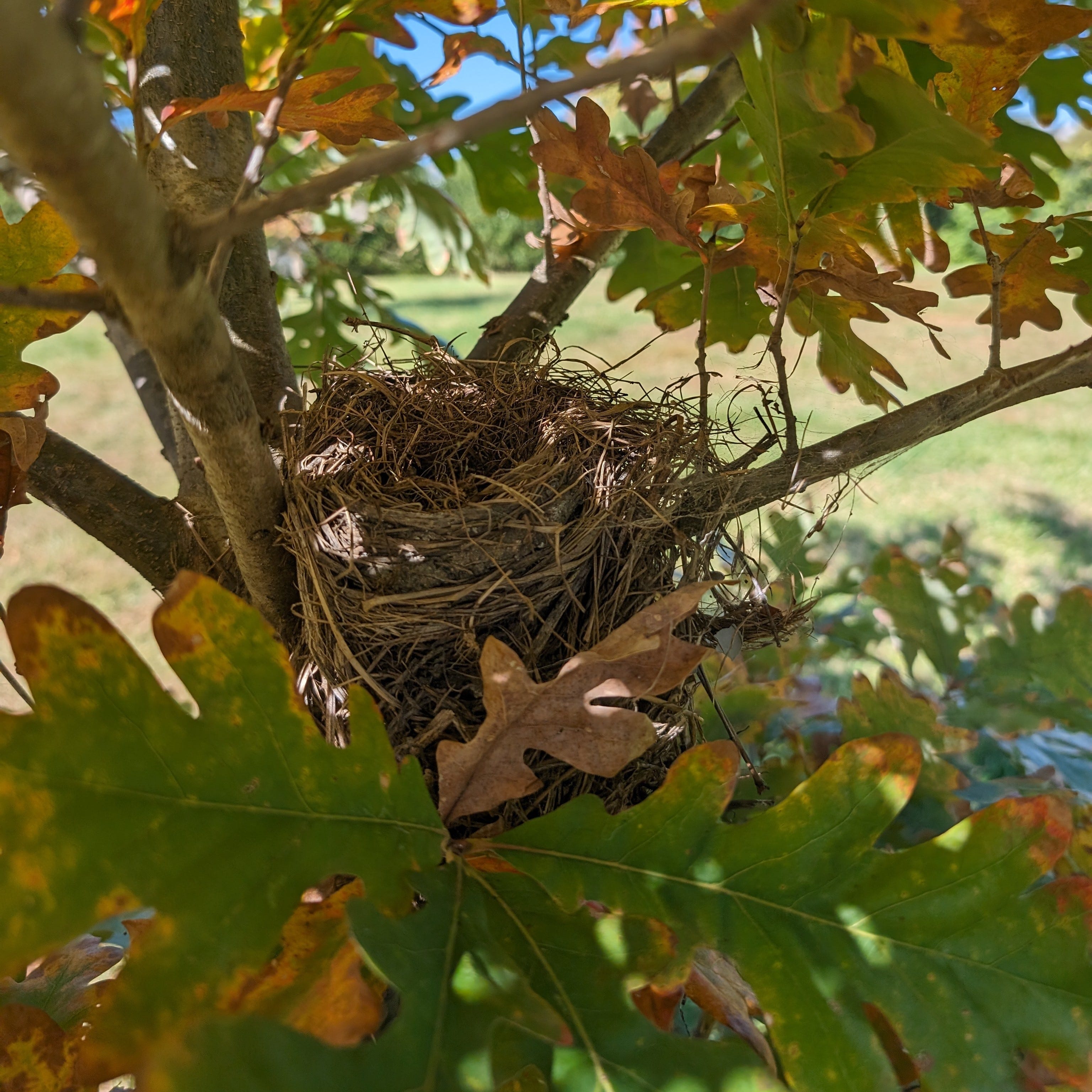
My trees seem to be mimicking the social unrest and political division that we are currently living through. Black oak is conventional and seems to have some idea how it is supposed to act. White oak, on the other hand, seems to want to defy all previous expectations of normal behavior. It seems obvious to me which one is doing a better job, yet despite this, birds chose the unconforming host, against their own best interests.
I don’t know what to make of this. Are my trees partisan? Or the birds? The insects? But I suspect that the outcome was totally random. Both trees are competing for resources in an environment lacking normal constraints. There are no old-growth trees around to provide them with role models, help define their growth, or serve as a source of new recruits for their insect populations. I suspect as they age they will become more like one another, until, after a few decades, they will be more or less indistinguishable. By that time, I hope they will have tempered their differences, become mature canopy members, and that both will support a wide diversity of constituent insects, birds, squirrels, and other wildlife. And maybe even a tree house.
At least until another tree takes root in my yard and upsets the balance of power.

Writing about nature is not easy. It requires preparation, hard work, and sometimes sweat to observe nature, and time, thought, and effort to describe it. Although this post is free, becoming a paid subscriber will help me continue to share my thoughts, and encourage future postings.
This issue of Ecologist at Large is available to all readers. However, if you would like to support my work with a one-off contribution, click “Buy me a coffee” below.
If you plant them (oaks) they (insects) will come. Give 'em time. As you had suspected, oaks do indeed host multitudes, more so than many other tree species. I can't recall the research, but if I'm not mistaken white oaks (as a group of species) do indeed host greater insect diversity than the black oaks (also a group). I'm not sure they're taxonomically valid groups, however. In any event, the Lepidoptera diversity alone could be hundreds of species on white oaks at your latitude, and still plenty on black oak. Let's hope we're around to see that abundance of moths and butterflies!
Also, if you want to kill your lawn with a beautiful, fast-growing tree, try black walnut, and don't rake the leaves. Looks like you've got lawn aplenty.