
Bad Inventions
In which the E@L discloses his most egregious scientific failures

E@L Episode #26-07
One of the things I loved about being a marine scientist was the opportunity it provided to be creative. In order to answer a scientific question, or test a hypothesis, I needed specific apparatus for that purpose. That sometimes meant inventing something that could be put into the ocean to observe or capture animals or finding a container in which to hold my study animals in the laboratory. And while some of them worked successfully, others were failures with descriptions ranging from dismal to spectacular.
The Underwater Mouse Trap
In 1991, using a two-person submarine called the Delta, I discovered that Tanner crabs (Chionoecetes bairdi) formed high density spawning aggregations in deep (200 m) water near Kodiak, AK.

The aggregations consisted of a large number of mounds, each containing hundreds of female crabs. But we didn’t know the maturity status of the crabs involved, or why they formed mounds. Using the sub’s grabber and some plastic milk crates, we were able to capture individual crabs, but I wanted to capture a complete (or partial) mound of crabs to see what it contained. In order to do that, I created a sort of underwater mouse trap. The trap consisted of two milk crates hinged together along one side, and held together by bungie cords. The trap was “set” by opening the gap between the baskets and holding them apart with a steel bar that was held in place with a pin. When the pin was removed, the bungie cords caused the two baskets to come together quickly with a loud “SNAP”, just like a mouse trap. In the lab, it worked perfectly, almost severing my hand in the process.
The idea was to use the submarine to lower the “trap” over a mound of crabs, then pull the pin to release the trap and capture the crabs. But before we took it out to sea, I thought perhaps it would be a good idea to test it in shallow water. Using scuba gear, I descended to the bottom of a shallow bay. My colleagues then lowered the trap into the water from a boat, and I pulled the pin. No SNAP. Instead, the baskets moved in slow motion, and dug into the muddy bay bottom, which prevented them from closing. What I had not realized was that the increased resistance caused by the density of water would prevent the baskets from moving rapidly or closing completely. In the water, the trap was a spectacular failure. But that test prevented us from wasting valuable ship and sub time trying it out. The lesson learned was “Never expect anything to work underwater like it does on land”.
The Awful Tower
More recently, my graduate students and I were studying the behavior of black sea bass (Centropristis striata) off the coast of Maryland. We started by placing Go-Pro cameras on fish traps to observe the fish going into and out of (yes, most of them escape) the traps. But we noticed that fish usually swam into the current, so we wondered if we could build a camera platform that would do the same. This time, rather than spend my time and effort building underwater contraptions, I recruited a senior engineering student, who would work under the supervision of my PhD student, Dan Cullen. The idea was to build a solid metal base with a rotating platform on top to hold the camera facing into the current. The student had lots of ideas about bracing, spindles, bushings, rotors, and vanes, so we gave him the tools and materials and let him go to town. What he came up with looked like a miniature, two-meter-tall version of the Eiffel tower with a wind vane on top (which we dubbed the “awful tower”). Dan and I had our misgivings about it because it was narrow and rather fragile, but we took it out for a test anyway. Besides, I like to let my students make their own mistakes to see what they can learn from the experience.
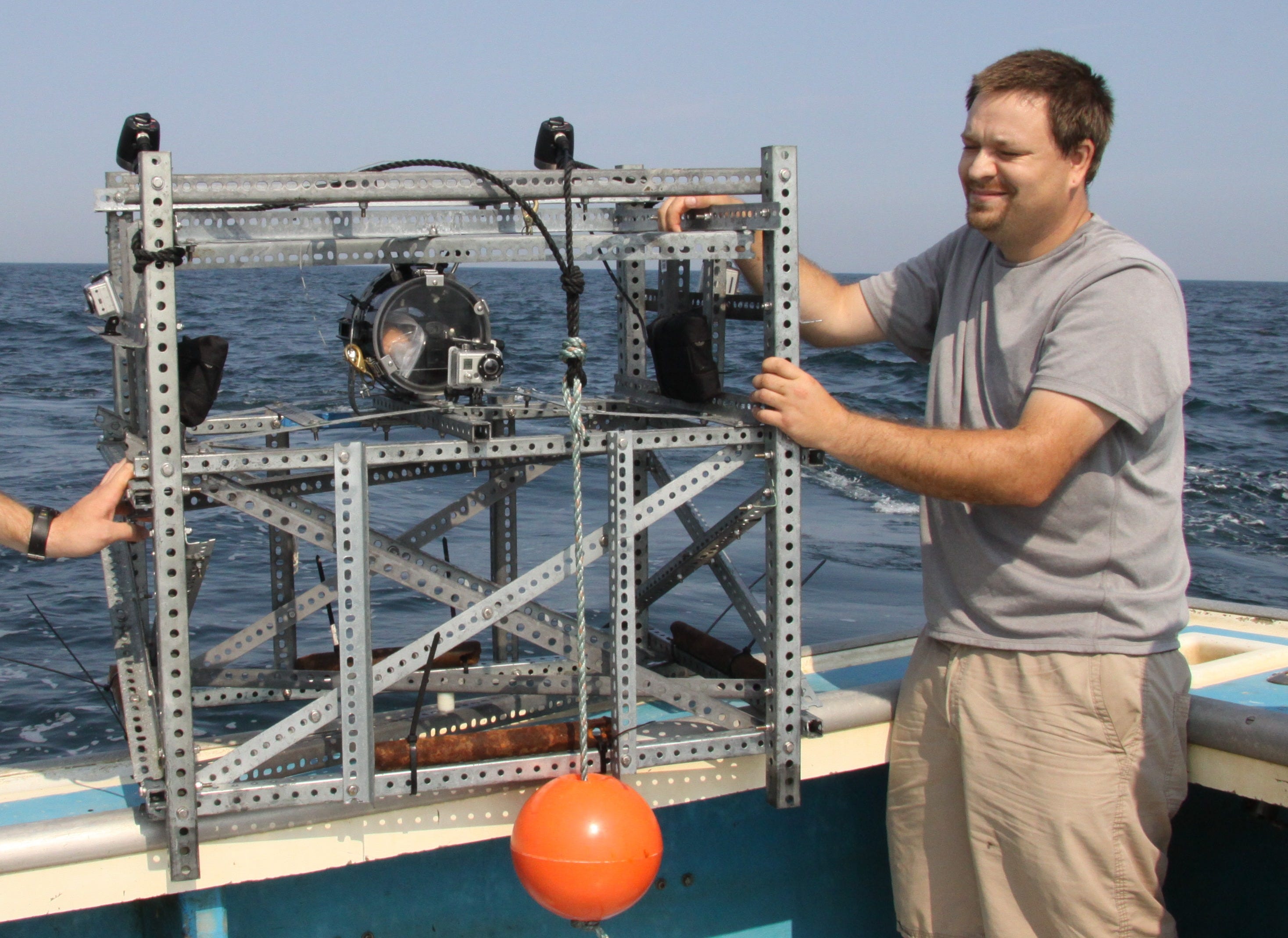
To test it, we chartered a fishing boat to take us fifteen miles offshore. The wind was blowing 15 knots, and seas were about 2 m high, so we were rocking around quite a bit. On our first attempt to launch the “tower”, we knocked the vane off. On our second attempt, we got it to the bottom, but the current knocked it over. On our third attempt, the whole device got slammed against the side of the boat by a wave and bent in half. That was the end of the awful tower – a dismal failure. The lesson learned was “Never underestimate the power of the ocean”. We finally built a fish-camera platform that was solid, square, and low to the ground so it was much more stable. But it didn’t rotate with the current – that invention is still waiting for its creator.
Thar She Blows!
During my first year as an Associate Professor at the University of Masschusetts, Dartmouth, I was desperate to obtain funding for my own research. That year, I submitted a dozen grant proposals. Most were in my field of knowledge (marine biology and fisheries), but some were definitely “out there”. One of these was a proposal to alert ships to the presence of whales by monitoring for whale spouts in order to avoid ship strikes.
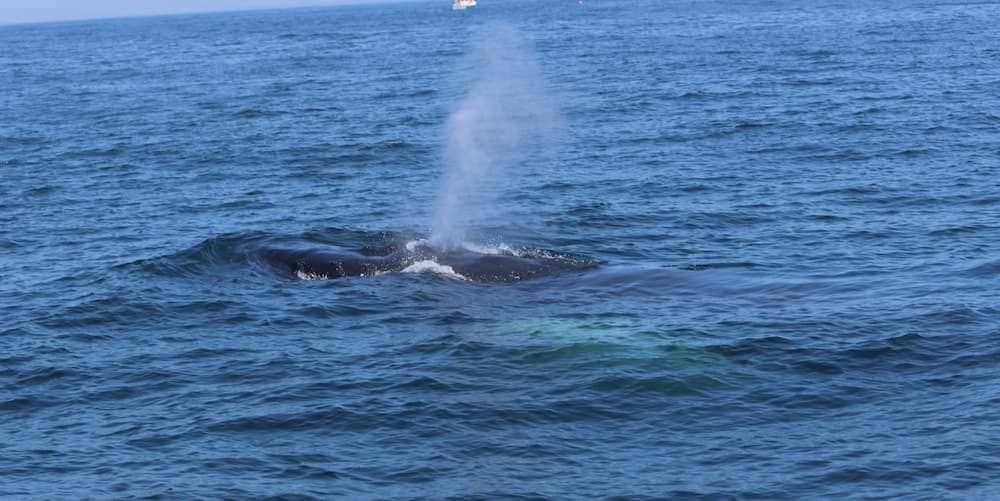
Ship strikes are the leading cause of death for North Atlantic Right Whales, whereas entanglement with fishing gear is the major cause of whale deaths worldwide. The best way to prevent ship strikes is by enacting maximum speed limits when ships traverse known whale migration routes, which has been done in a number of locations. This allows both ship operators and whales the opportunity to avoid being hit.

My idea was to use infra-red cameras mounted on gimbaled, deck-mounted tracking devices of the sort used for movie cameras. Automated software would detect when a whale spout was sighted and alert the helmsman to its location. (AI software available today could do this easily, but at that time, it was a long shot). I even talked with some Hollywood people who rented and operated the equipment, to find out how it worked. The idea was so far out that even I wasn’t sure it would work. So, I wasn’t surprised or upset when my proposal was roundly rejected. Maybe not a dismal failure, more like a deflated balloon. The lesson learned was “Stick to what you know”. In the back of my mind, though, I felt like I was on to something, and I still think it could work.
Pouring Oil on the Water
The great thing about failing at a scientific test or experiment is that it creates an opportunity for another enterprising investigator to step in and succeed. If they can improve on your idea or design an alternative, they may be able to accomplish what you did not. Personally, I hope that some young scientist will try to tackle some of these problems someday and do a better job than I did. I will feel as if I helped pave the way for them by showing what DOESN’T work.
Speaking of whales, scientists have recently discovered a new species of whale hiding under their noses, with only 50 remaining members. The new species, named Balaenoptera ricei, or Rice’s whale, is a relative of the Bryde’s whale, and lives only in the Gulf of Mexico. The Biden administration proposed removing 6 million acres from a planned offshore oil and gas lease sale in the GoM to protect the whales from the consequences of future oil spills in the area. President Trump, true to form, recently forced a resolution by the “Endangered Species Committee” to exempt oil drilling in the Gulf from the Endangered Species Act, which is a direct threat to Rice’s whales. Now they are subject to being poisoned by oil spills in their habitat.
But the bigger threat, still, is being stricken by ships, due to the enormous amount of ship traffic traveling through the Gulf, and because the whales sleep on the surface at night, when they are most vulnerable to ship strikes.
Maybe it’s time someone invented an automatic whale detection device for use aboard ships. Something that might involve deck mounted camera systems, infra-red heat detection, and AI identification software? It seems like maybe an idea whose time has come.

This issue of Ecologist at Large is available to all readers. However, if you would like to support my work with a one-off contribution, click “Buy me a coffee” below.
I’d think the camera attached to a flat round turntable with a weathervane like rudder at the back of the camera box, all within the sturdy metal frame shown in the photograph would allow for current rotation and the larger frame give some stability as it sits on the bottom. The disadvantage is as the camera rotates within the frame, the metal frame will keep showing up in the photos/video feed.
I do have to ask, knowing the resourcefulness and limited budgets of grad students, if those were real milk crates (the real ones are beefier, thicker plastic and sometimes with a little metal) such as those found in the ever dwindling stack of the midnight loading dock behind the local grocery store.