
We Love Shrimp!
In which the E@L extols the virtues and vices of America’s favorite seafood

Sustainable Seafood # 30
Newspaper Shrimp
When I was a kid, my family spent two weeks every summer on North Carolina’s outer banks. One of the highlights of the trip was when my mom would boil up several pounds of freshly caught shrimp (which she pronounced “sree-imp” in her Georgia accent) and spread it out over newspaper on a picnic table for us to eat. I loved picking off the legs, peeling off the shell, and dipping the tasty tails in spicy cocktail sauce. “Newspaper shrimp” my sister and I called it.


We Love Shrimp! It is America’s favorite seafood. We love shrimp so much that we import more of it than any other seafood we eat. In 2022, the United States only caught 106,000 metric tons (t) of shrimp, but we imported 873,000 t of the stuff, equal to 88% of our total consumption. Anytime you buy shrimp in a restaurant or store, there is a 90% probability that it was imported from another country. Actually, it’s higher than that, because wild-caught shrimp are mostly available in the summer, and in the Southeast, so depending on the season and where you live, your likelihood of finding wild American shrimp is infinitesimally small.
So where does all this shrimp come from? When we think of shrimp, the image that comes to mind is a white boat rolling on a blue sea, hauling up nets bulging with wiggling pink crustaceans, and dumping them on deck to be sorted by sunburnt fishermen. This image is seared into our minds by movies such as Forest Gump and The Prince of Tides. But the reality? Most shrimp are farmed in ponds dug out of mangrove swamps in Southeast Asia or South America, and harvested by sunburnt, overworked, underpaid laborers, and some of that shrimp is processed by refugees working under slave-like conditions in Thailand or China (more on that later).


Fact is, most shrimp on the market is produced by aquaculture. This is actually one of the financial and biological success stories in Aquaculture, although the ecological and social costs make it a questionable success. In the US, only 12% of marketed shrimp are US wild-caught; 78% come from Asia, and another 22% from South America. Around the world, the top producers of shrimp are India, Indonesia, Ecuador, Vietnam, and Thailand.
One Genus to Rule them All
Most of the shrimp we eat belong to the genus Penaeus (or did so before they were re-named). Penaeid shrimp are warm-water coastal species, living in the nearshore zones of most countries between the tropics of Cancer and Capricorn. In the US, three species are dominant. Along the southeast coast of the Carolinas and Georgia, White Shrimp Litopenaeus setiferus are most abundant. Farther south into Florida, Pink Shrimp Penaeus duorarum become abundant, and Brown Shrimp Penaeus aztecus are more common in the Gulf of Mexico.
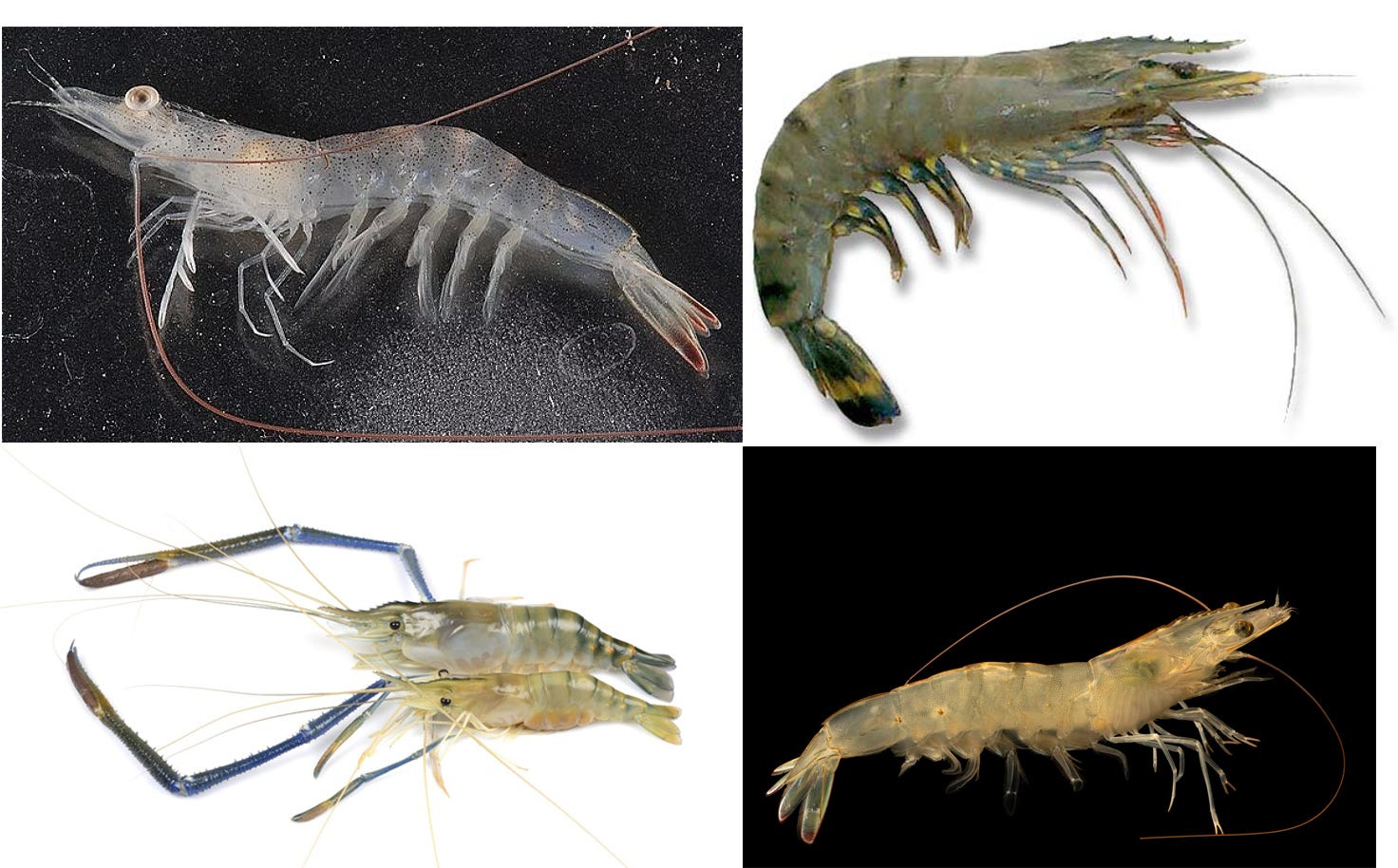
Imported (cultivated) shrimp are dominated by Tiger shrimp Penaeus monodon, the most widely cultured shrimp in world. Whiteleg shrimp Litopenaeus vannamei are becoming more abundant though, because development of disease-resistant strains has made them more profitable. Other shrimp in the grocery store include Kuruma shrimp Marsupenaeus japonicus. Argentine Red shrimp Pleoticus muelleri are one of the few wild-caught shrimp available.
Northern or Pink Shrimp, including Pandalus borealis and P. jordani, are a totally different kind of shrimp, often sold as “popcorn shrimp” or more recently, cooked in a spicy Asian sauce as “bang-bang” shrimp. These are small shrimp that live in cold waters, forming huge schools in the boreal waters off the Northwest Coast of the US, including Oregon, Washington, and Alaska, and along both the Pacific and Atlantic coasts of maritime Canada. Other Pandalid shrimps are common in boreal waters, including Pandalus platyceros, known as “spot shrimp” in the Pacific Northwest, and mostly caught with pots or traps as a subsistence fishery.
Northern shrimp were once a major component of the boreal marine ecosystems in the North Atlantic and North Pacific Oceans but have declined dramatically as ocean temperatures have warmed. In the 1970’s shrimp fishing was a major activity in Coastal Alaska, but most of the shrimp disappeared in the 1980’s, and their biomass was replaced by pollock (which, ironically, is used to make fake shrimp).
All of the Penaeid shrimp are large and sold either cooked or uncooked. Prices range from $8 per pound for small shrimp (50-60 count, i.e. shrimp per pound) to $25 for larger shrimp (15-20 count), whereas Northern shrimp are small (80-100 count) and sell for about $15-20 per pound.
Down on the (Shrimp) Farm
Around the world, fifteen species of shrimp are produced by aquaculture. Much of the technology for this was developed in the United States at places like Louisiana State University. But growing shrimp requires lots of land and water, or saltwater ponds on the coast. In the US, land prices are expensive, and coastal mangroves are protected from destruction, so most of the production is now done in other countries. The species cultivated include Tiger shrimp, Penaeus monodon, Whiteleg shrimp, Litopenaeus vannamei, Kuruma shrimp Marsupenaeus japonicus, and Chinese Whiteleg shrimp Fenneropenaeus chinensis.
Most shrimp culture starts with wild broodstock – adults captured from wild populations. But some cultivation is now conducted with captive, fast growing, and disease-resistant strains. One of these is Litopenaeus stylirostris – the so-called “super-shrimp”. Pairs of adult shrimp are placed in solitary cages for spawning. Sperm may be extracted from male shrimp and used to artificially inseminate females (which I unsuccessfully attempted to imitate with crayfish). Females release fertilized eggs into the water, which are captured and cultivated in one of two ways.
Extensive Cultivation occurs in ponds that may be up to 1 hectare (ha) in size and 2 m deep. In many countries, such as Vietnam, these are carved out of coastal mangrove forests. This has detrimental ecological consequences because mangroves protect coastlines from storms and erosion and are nurseries for juvenile fish, shrimp, and crabs, as well as habitat for birds and reptiles. And they absorb large amounts of atmospheric carbon dioxide. So, destroying mangroves degrades coastal habitats. Many countries such as Ecuador and Indonesia now recognize these problems and are trying to move shrimp farms back from the coast and rebuild or replant their mangrove forests.


Ponds built on land may be lined with plastic or concrete and aerated with paddlewheels. Some of these are also used for polyculture with Tilapia and southeast Asian mud crabs (Scylla serrata). Shrimp in the ponds are fed pelleted diets plus trash fish (bycatch from wild shrimp fisheries) or mussels. Cultivation of Penaeus monodon can produce 5-10 tons of shrimp per ha. In contrast, Tilapia cultivation routinely produces 200 tons/ha.
Intensive cultivation occurs in indoor tanks, usually far inland from coastal areas. Places where this occurs include Saudi Arabia, and US states including Hawaii, Missouri, and Maryland. Some tank systems use recirculating water with Biofloc, a mixture of algae, bacteria, and some carbohydrate source like molasses or rice bran. These “Zero-exchange” systems use very little water, because all the wastewater is captured and reused. This reduces waste discharge and opportunities for disease introduction.
The Giant Shrimp that Ate My Lunch
One type of cultivated shrimp is the giant Malaysian freshwater prawn Macrobrachium rosenbergii. It has blue claws at the end of appendages that are longer than its body. As a graduate student in Fisheries Science at the University of Washington, I studied aquaculture with Dr. Ling Shao-wen, who developed the cultivation techniques for Macrobrachium. When he began his work, he thought the shrimp spent their whole lives in freshwater streams. In his laboratory, he put pairs of shrimp in aquaria, but after they mated and released eggs, the larvae would die before they developed. Every day he added something different to the water to see if it would help the larvae survive. Nothing worked. Then he started adding bits of his lunch. He tried rice, fish, and seaweed but still nothing worked. One day he put soy sauce into the water and a few larvae survived. The next day he added more, and more larvae survived. He realized then that the larvae needed salt in their water. This led him to the discovery that the shrimp eggs and larvae drifted downstream towards the ocean, and the larvae needed brackish water to survive.
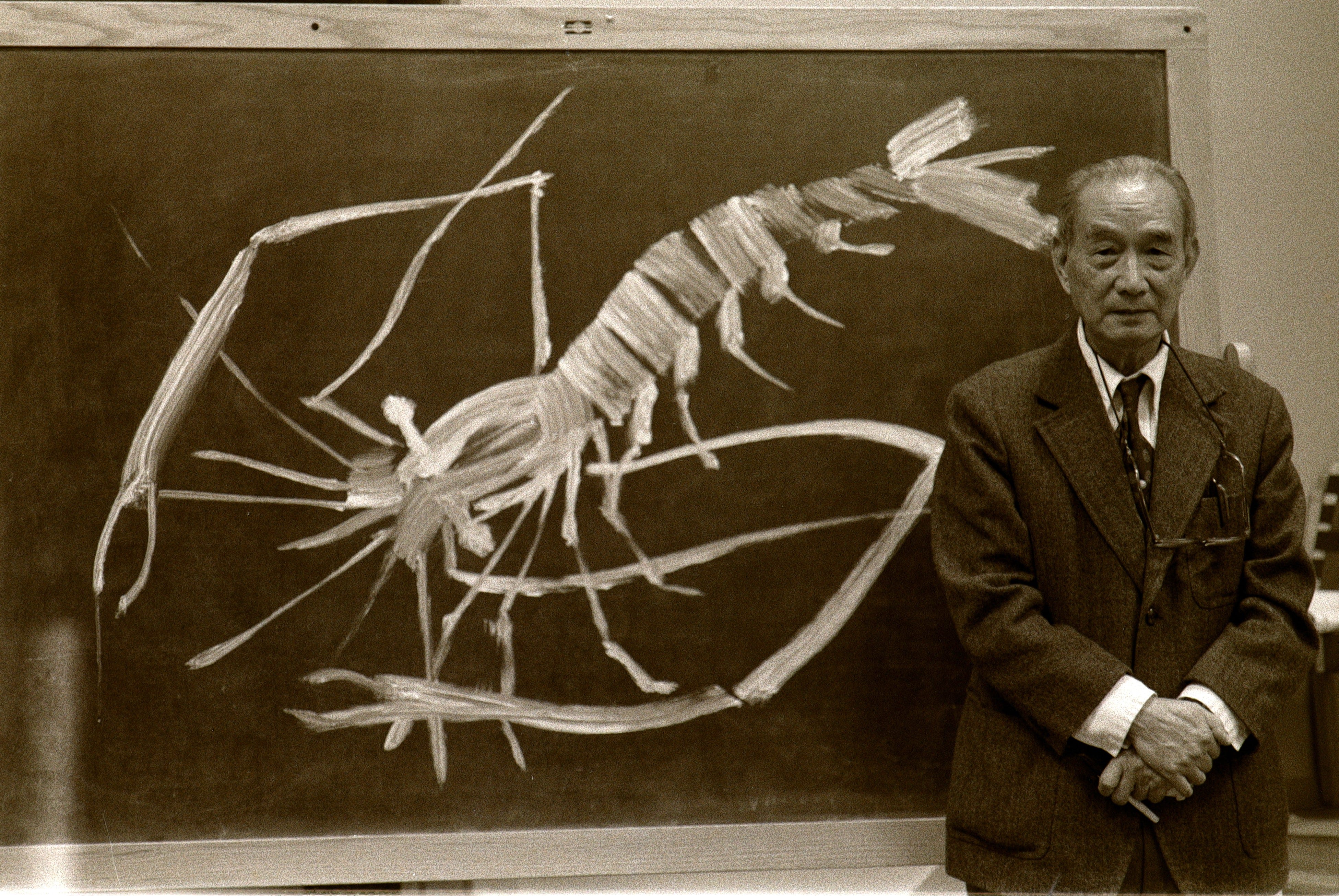
My fellow graduate students thought that farming Macrobrachium was the future, and many of us wanted to start our own shrimp farms. It’s a good thing, maybe, that we didn’t. The saying at that time was “Do you want to know how to make a million dollars in aquaculture? Start with two million”. Macrobrachium did not turn out to be our ticket to riches, but it is now a major aquaculture species in Thailand, Taiwan, and Vietnam. Adults are spawned in a laboratory, and larvae are released into growout ponds where they are fed pelleted diets. The adults are harvested by seine net. Over 200,000 tons/yr are harvested, which is a respectable amount, but just a fraction of the Penaeid shrimp produced. You can occasionally find these for sale in places like Costco or Sam’s club.
Small Shrimp Have Big Problems
Cultivation of shrimp has many challenges. Despite their wide availability and reasonable price, shrimp are still seen as a luxury product by many consumers. Increased production created oversupply, causing prices to decrease. Demand declined during the Covid years and subsequent inflation. Feeds require fish protein and oil, made from forage fish, which are getting scarcer following the collapse of Peruvian Anchovetta, increasing the cost of feed.
Disease is still a major problem, and much of the cultivation relies on one species, Peneaus monodon, which has a poor immune system and is susceptible to diseases such as white spot syndrome and acute hepatopancreatic necrosis.
Shrimp cultivation produces large amounts of waste due to feces and uneaten food, and this is often discharged into coastal waters. Fertilizers, chemicals, and feeds contribute nutrients that lead to eutrophication. Conversion of mangrove forests has resulted in major losses of mangroves. Half of the world mangroves have been lost since 1940, and 30-50% of this is due to shrimp farms.
Shrimp and Human Rights
Another major problem in the shrimp industry is human rights abuse and the use of slave labor. In southeast Asia, workers who are hired to work on shrimp fishing boats may be held at sea for months without being paid. According to a 2015 article in the Guardian, over 500,000 refugees from Myanmar have migrated into Thailand, where they constitute 90% of the seafood workforce. Almost 60% of them are working under forced labor conditions, and 30% have been trafficked or sold into this system. Many are captive in Thai shrimp peeling plants. Many workers are in forced detention in unlicensed factories, living in squalid conditions where their wages have been withheld. The shrimp they produce are mixed with other sources and sold worldwide, so it is difficult to determine the exact source.
Another 2024 article in the New Yorker described how North Korean workers were sent to China where they were forced to work in Chinese seafood processing plants in slave-like conditions, and all their wages were sent back to the government of North Korea.
The moral of this story is DON’T BUY SHRIMP FROM THAILAND OR CHINA.
Synopsis: Should You Eat Shrimp?
Freshly caught shrimp are one of the most nutritious seafood meals you can buy. They have medium levels of protein, and are extremely low in calories, fat, and sodium. Shrimp do not have much omega-3 fatty acids but do have moderate levels of cholesterol. If you are anywhere near the coastal regions of the US where shrimp are caught, you should eat them. Frozen shrimp can also a good dietary choice.
And how many ways can you eat shrimp? (See Gump, Forrest, The Movie). Shrimp can be steamed, boiled, fried, fricasseed, taco-ed, etouffee-ed, pasta-ed, jambalaya-ed, Caesar salad-ed, cocktailed, stir-fried, chowdered, stuffed, quesadilla-ed, ceviche-ed, and probably the best way of all, served with grits, fried green tomatoes and red-eye sauce. Just to mention a few.
But eating shrimp can have consequences. When done carelessly, shrimp cultivation can damage the coastal environment, and human rights abuses are rampant in the industry. To some degree, this is the result of trying to turn what used to be a luxury food into a commodity. So, be selective when buying shrimp – examine the package, and make sure you know what species it contains, and where they are from.
According to Seafood Watch, the Best Choice are indoor-farmed shrimp, which are primarily Whiteleg shrimp (P. vannamei). Northern Shrimp are Certified or a Good Alternative. White, Pink, and Brown shrimp are considered a Good Alternative, as are shrimp from Mexico, Ecuador, Honduras, and Vietnam. Avoid buying shrimp from India, Malaysia, Nicaragua, China, or Indonesia, as well as Argentine Red shrimp because populations have been depleted by overfishing, and large quantities of bycatch are discarded.
The Marine Stewardship Council only certifies wild fisheries, and has certified Northern Shrimp from the US, Canada, Nova Scotia, and Iceland, but has not certified wild trawl-caught shrimp from the Gulf of Mexico.
The Aquaculture Sustainability Council certifies shrimp that are produced using sustainable methods, so look for their seal on the package.
In summary, Shrimp are great food, and wild-caught shrimp are highly sustainable. But most of the shrimp on the market are cultivated, which are less sustainable due to mangrove destruction and waste production, but this situation is improving. And human rights abuses should deter you from buying shrimp from Thailand or China.
Finally, the Stevens Palatability Index (SPI) for shrimp is 5. I always keep a bag of frozen shrimp in my freezer, which I cook with stir fried vegetables or add to fish chowder. If I can’t get wild-caught shrimp, I prefer to buy shrimp from Ecuador or Vietnam, both places that are free of human rights issues, and have made major strides in decreasing their destruction of coastal mangroves. And we did so much damage to Vietnam during our war there, that the least we can do for them is buy their shrimp.
My sister and I still go to the Outer Banks for summer vacation. And we always have us a big feast of “newspaper shrimp”. And just for you, I’ll put another shrimp on the barbie.


This issue of Ecologist at Large is available to all readers. However, if you would like to support my work with a one-off contribution, click “Buy me a coffee” below.
Resources
https://www.newyorker.com/magazine/2024/03/04/inside-north-koreas-forced-labor-program-in-china
I no longer eat shrimp, after learning about how they are farmed and have their due stalks cut off. Horrible all around.